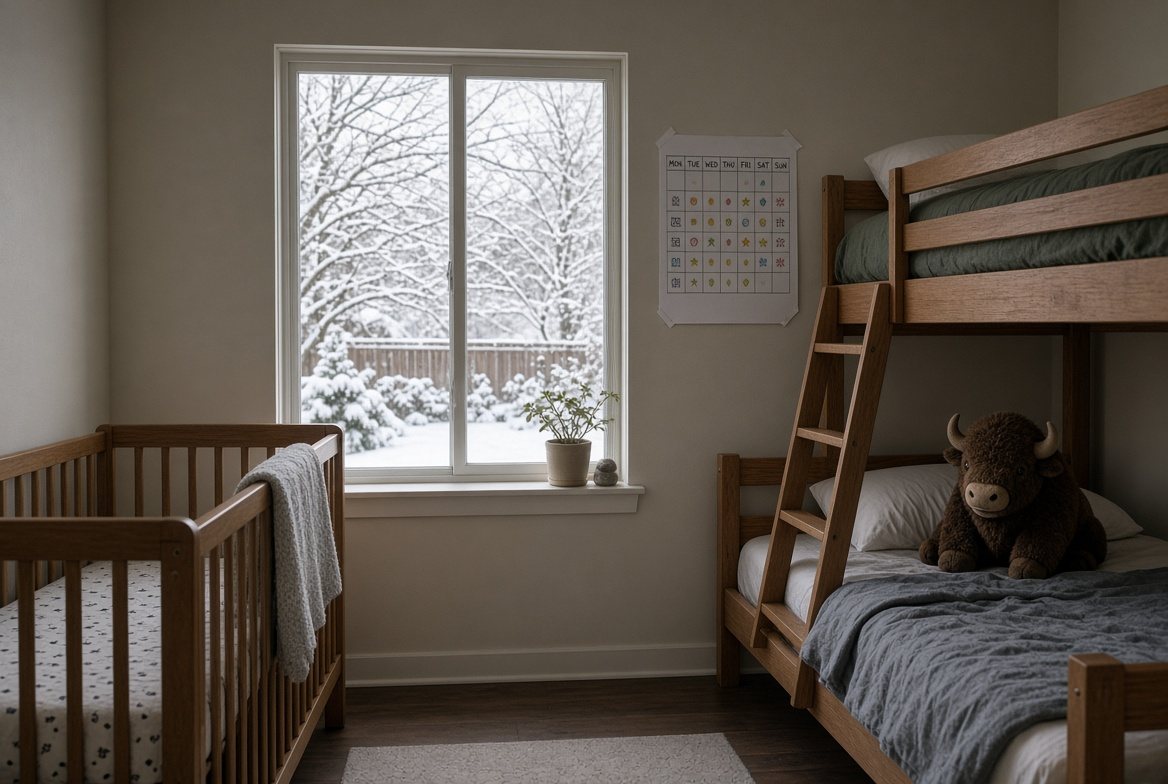
A parenting schedule that works in Jackson, by age and by season.
The custody statute tells the judge what to weigh and says nothing about Tuesdays. The schedule is where a custody case becomes a life: who has the children on a powder day, who drives over the pass, where a two-year-old sleeps on Wednesday. Wyoming requires the decree to spell it out in well defined terms, and this page is about getting those terms right the first time.
Call or text me. Clients get my cell number from day one, and I answer. Just been served? Here's what happens next.
Three rules the schedule has to obey.
The court "shall order custody in well defined terms to promote understanding and compliance" and may not favor or disfavor any form of custody (W.S. § 20-2-201(d)). Visitation must be ordered "in enough detail" to be followed (W.S. § 20-2-202(a)(i)). Days, times, places, and who drives.
When each parent keeps the children overnight for more than twenty-five percent of the year and both pay substantially toward their expenses, child support is computed on a shared-responsibility formula rather than the ordinary table (W.S. § 20-2-304(c)). The overnight count in the schedule is also a support number.
The decree must allocate the cost of transporting the children for visitation and must require thirty days' written notice before either parent changes home city or state (W.S. § 20-2-202(a)). In a valley where one parent often lives in Victor or Alpine, those two lines do a lot of work.
Age first, then geography, then the calendar.
What changes as children grow
An infant or a toddler needs frequent, short contact with each parent and the same crib most nights, so the youngest children's schedules are built on two or three short blocks a week with the other parent, extending to overnights as the child settles, with the plan saying when the next step happens so nobody has to go back to court to add a Friday night. By preschool a child can handle longer blocks, and the 2-2-3 and 2-2-5-5 rotations make sense if the parents share a school. By ten or twelve most children can manage a week at a time, and by high school the schedule has to bend around sports, jobs, and a teenager's own calendar: fewer exchanges, and a clause that lets practice win without a motion.
Geography comes next: a rotation with exchanges every two days works when both homes are in town and fails when one parent lives in Teton Valley, Idaho and the pass closes. The statute lists the distance between the homes as a factor in its own right; the custody page explains the rest of the eleven. Last comes the calendar: the school year, the ski-season work weeks, the summer the resort runs on, and the holidays.
- 01The regular schedule by day of the week, with exchange times, including school nights and the midweek evening
- 02Holidays and long weekends, alternated by odd and even years or fixed, each with a start and end time, overriding the regular schedule
- 03Summer, winter break and spring break, with the date by which each parent must give notice of vacation travel
- 04Exchanges: where, who drives, what happens when the pass or the canyon is closed, and how transportation costs are divided (§ 20-2-202(a)(ii))
- 05Decisions: school, medical care, counseling, activities, travel outside the country, and what happens when the parents disagree
- 06Communication: how the parents talk to each other, how and when the children reach the other parent, and a shared calendar
- 07Thirty days' written notice before a parent moves (§ 20-2-202(a)(iii)), and a long-distance schedule that takes over if the homes end up far apart
Items 4 and 7 are required by W.S. § 20-2-202(a); the rest are what "well defined terms" under § 20-2-201(d) means in practice.
The four schedules most Jackson families choose between.
- Primary home, alternating weekends. The children live with one parent during the school week and spend alternating weekends, Friday after school to Monday morning, plus a midweek dinner or overnight with the other. With a midweek overnight the second parent crosses the twenty-five percent line. Fits parents with very different work hours, young children, or homes far apart.
- 2-2-3. Two nights with one parent, two with the other, then a three-night weekend, alternating so each parent has every other weekend. Equal time, and no child goes more than three nights without a parent, which suits preschool and early-elementary children. The price is seven exchanges in two weeks, which only works when both homes are in town and the parents can hand off at school without a word.
- 2-2-5-5. Monday and Tuesday always with one parent, Wednesday and Thursday always with the other, weekends alternating in five-night blocks. Equal time, fewer exchanges, and a fixed midweek pattern children and employers can memorize. The schedule I draft most often for school-age children of parents who both work in town.
- Week-on, week-off. Seven nights with each parent, exchanging at school on Monday morning, often with a midweek dinner to shorten the gap. Equal time with the fewest exchanges, which makes it the schedule for older children, for parents who do not get along at the curb, and for a parent who lives over the pass. Hard on children under six, who lose track of a parent in a week.

Seasons, holidays, the pass, and two-home families.
Ski-season and summer work, the holiday table, exchange logistics, right of first refusal, long distance, and Teton County
Seasonal work, in a town that runs on it
Half the parents I represent do not have the same job in February that they have in July. A ski patroller, a fishing guide, a contractor who pours foundations from May to October: each has months of fourteen-hour days and months of almost nothing. A schedule copied from a city form ignores that, and one parent ends up handing the children to a sitter every scheduled day of the busy season. The fix is a seasonal schedule written into the decree: a winter rotation and a summer rotation, each with its own dates, the ordinary pattern governing the shoulder seasons. "The summer schedule runs from the Monday after school ends to the Sunday before it begins" is as well defined as the statute requires.
The holiday table
Holidays override the regular schedule, and the table that lists them is the part of the plan parents read most: winter break, usually split at a stated date and alternated; Thanksgiving; spring break; the Fourth of July; birthdays; Mother's Day and Father's Day; any religious holidays the family keeps. Each entry needs a start, an end, and an odd-year, even-year assignment, and vacation time needs a notice date so one parent's trip to Mexico is not booked over the other's week at the lake. A good holiday table makes most other disputes disappear, because the days people actually fight over are already decided.
Exchanges, and the pass
Exchanges at school are the best kind: the child goes to class from one home and leaves for the other, and the parents never meet. When school is out, the plan names a place and a time and says who drives. For a parent in Victor or Driggs the plan needs a weather clause, because Teton Pass closes and so does the Snake River Canyon, and the answer to "what happens then" belongs in the decree rather than in a text exchange at nine on a Friday night: the receiving parent takes the children when the road opens, missed time is made up on a stated basis, and nobody drives the pass with the children in conditions a reasonable parent would not. The decree must allocate transportation costs (W.S. § 20-2-202(a)(ii)); for a commute over the pass, the parent who moved usually pays for the miles.
Right of first refusal and the small clauses
A right of first refusal is the clause people ask for most and regret most. Set the trigger long enough that it does not reach a dinner out, say whether a grandparent counts as the parent's own care, and set a time by which the other parent must answer. Add the small terms that prevent most motions: a shared calendar, swaps confirmed in writing, video contact with the other parent at a set time, a clause on passports. None of it is in the statute. All of it is what "promote understanding and compliance" looks like on paper.
Two homes, two states
Jackson has more two-home families than most towns its size. No schedule splits a school-age child between Jackson and another state during the school year, so the long-distance plan gives the school year to one home and the bulk of summer and long breaks to the other, with flights paid on a stated basis and video contact in between. A move after the decree can reopen custody (changing a custody order); the best plans anticipate it with a clause that converts the local schedule to the long-distance one once the homes are a stated number of miles apart.
In Teton County
Every custody case in the county is heard by Judge Melissa M. Owens, the district's only judge. Where custody is contested at a hearing or trial she requires a guardian ad litem, who looks at both homes, speaks with teachers and daycare providers, and reports on how each proposed schedule would work for the child. A child old enough to have a view is interviewed in chambers with the court reporter and the lawyers present and the parents outside; each side may submit up to three questions. The temporary schedule, entered early on affidavits, usually governs for months (temporary orders), and hearings are in the temporary courtrooms at 250 East Simpson Avenue until the Justice Center opens (courthouse page). Once the schedule is ordered, child support follows from the overnight count, and the enforcement page covers the parent who ignores it.
What parents ask about the schedule.
What is the most common parenting schedule in Wyoming?
How does the schedule affect child support?
What is a right of first refusal, and should my decree have one?
Can we write our own schedule, or does the judge decide?
What happens to the schedule if one of us moves away from Jackson?
Will my child have to testify about which schedule they want?
 Tool · two minutesWyoming child support calculatorThe statute's table, gross to net, shared custody. Run it before anyone quotes you a number.
Run the calculator →
Tool · two minutesWyoming child support calculatorThe statute's table, gross to net, shared custody. Run it before anyone quotes you a number.
Run the calculator →
Start with a confidential conversation with Aaron Herzberg.
A consultation is a scheduled working session, in person in Jackson or by video, in which we go through your situation and I tell you what I would do. It is a paid working session, not a sales pitch. The fee is quoted when we schedule. Your note reaches me directly, my office runs the conflicts check and puts the meeting on my calendar, and you can call or text any time.
40 E Simpson Ave, Jackson, WY 83001 · by appointment · video consultations for out-of-state clients · info@puzzlegroup.com