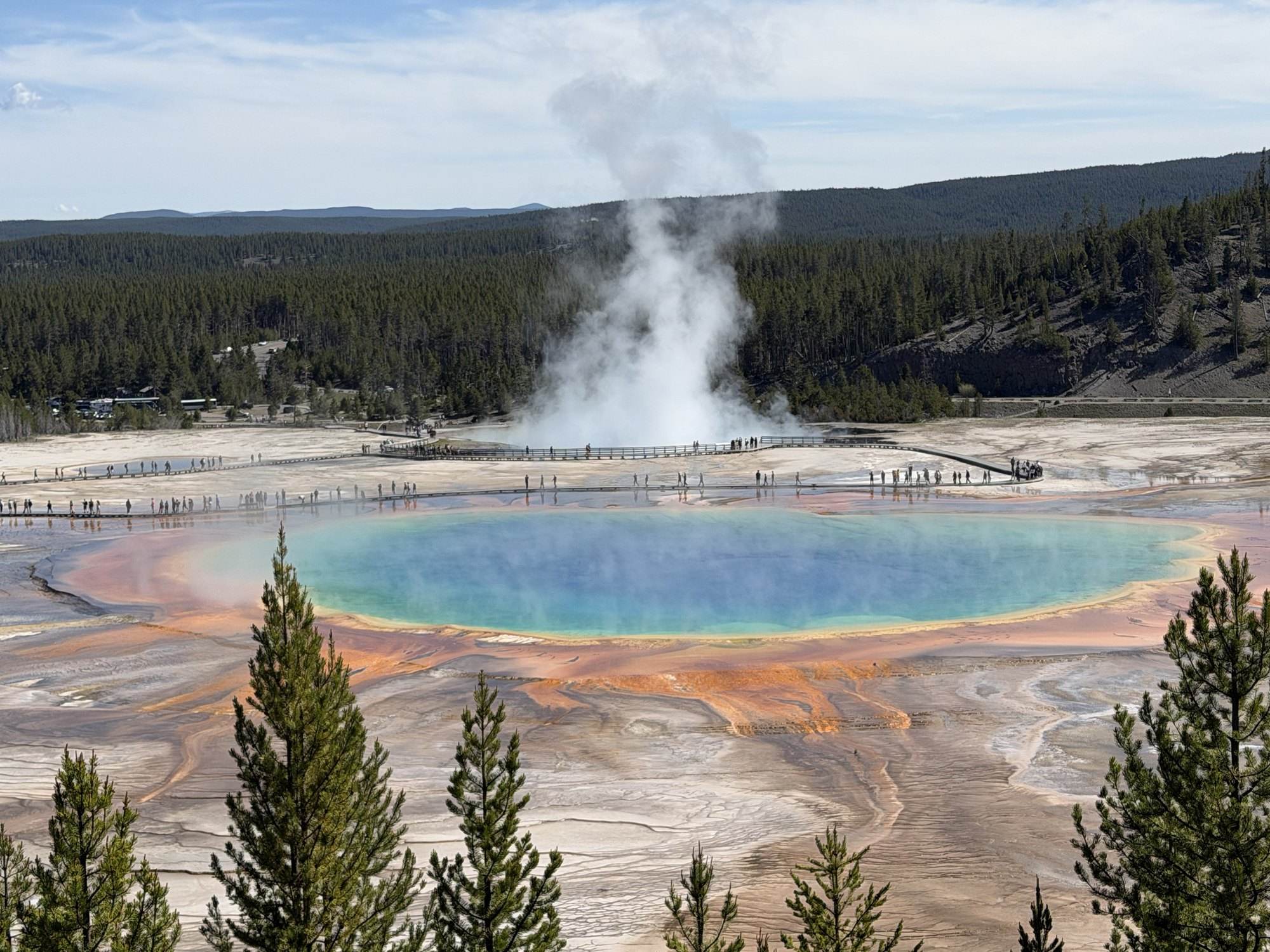
Cited for walking off the boardwalk in Yellowstone National Park.
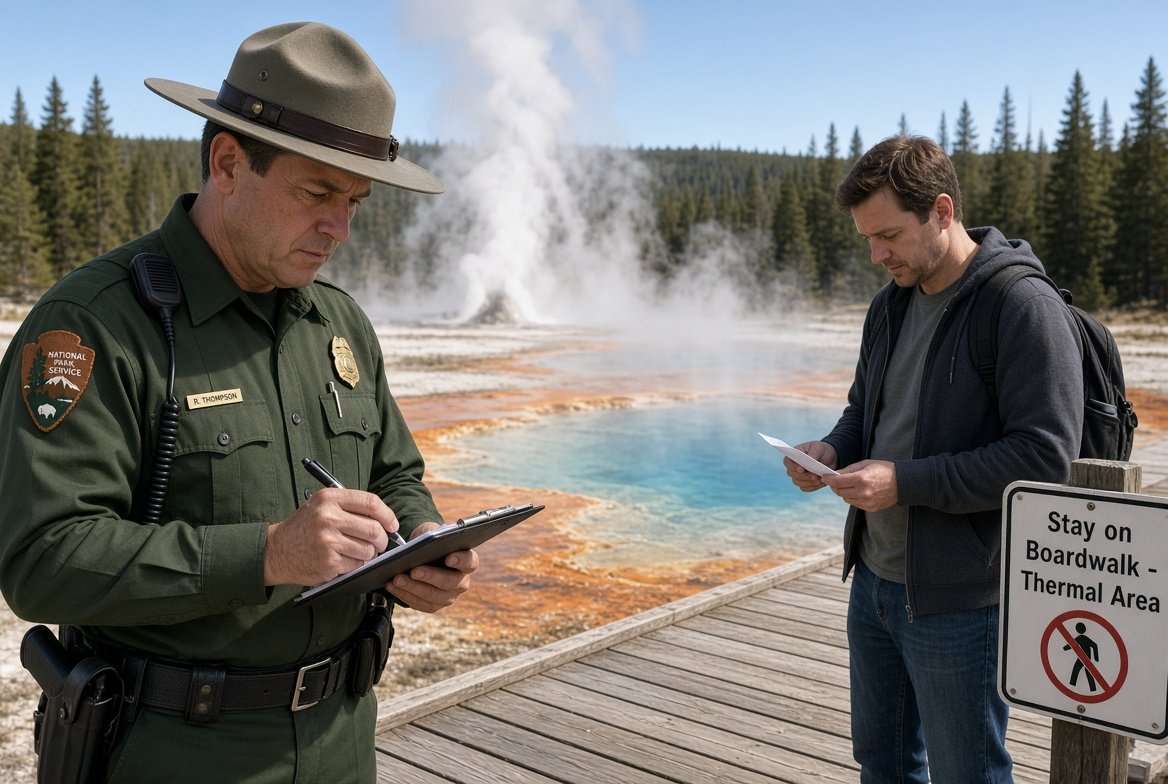
Yellowstone has a regulation written for it alone: in every thermal area, foot travel stays on the boardwalks and the marked trails. A ranger who sees you off them, or is sent a video, writes a federal violation notice that cannot be paid by mail. Most of the people it charges wanted a better photograph.
Call or text me. Clients get my cell number from day one, and I answer. Got a violation notice? Here's what happens next.
Read it in your language. Talk it through in your language.
Every page of this National Parks chapter is written in Chinese, Korean, Japanese, Spanish, French, German and Italian. The consultation is a video call with attorney Aaron Herzberg, carried in your language by live translation software, at no additional charge.

One regulation, written for Yellowstone.
This one names Yellowstone: "Foot travel in all thermal areas and within the Yellowstone Canyon between the Upper Falls and Inspiration Point must be confined to boardwalks or trails that are maintained for such travel and are marked by official signs" (36 CFR § 7.13(j)).
A single step past the boardwalk is the offense; how far you went is a sentencing fact. The compendium defines a thermal area as any place with hot springs, geysers, mud springs, fumaroles, or warm ground at the surface.
The thermal rule is written as a rule about where feet may go, and unlike the wildlife-distance closure, which prohibits knowingly approaching, it contains no word like knowing or willful. Not seeing the sign rarely defeats the count.
Why a few steps are prosecuted.
The Park Service's safety page says burns from thermal features are a common cause of serious injury and death in the park, and the U.S. Geological Survey's Yellowstone observatory counts twenty-two scalding deaths since 1872 and hundreds of injuries. The U.S. Attorney's Office has said in writing that it will seek significant penalties, including jail, for willful violations. The facts that separate you from them, no fence, no damage, no warning ignored, a few feet and a few seconds, are the whole conversation with the prosecutor.
- 01Custody: two to seven days in every announced case that carried it
- 02Fines: $350 to $3,000 in the recent cases; one 2016 Grand Prismatic judgment passed $8,000 with restitution and payments
- 03Probation: none in several cases; two to five years, unsupervised, in the others
- 04Bans: none, or two to five years from Yellowstone; once, from all federal Interior, Agriculture and Army Corps land
- 05Payments: $106.92 in restitution for a damaged mat; $500 to $1,000 to the park's geological fund
- 06The one the court cut down: the government asked for two years' probation and the $5,000 maximum against a well-known actor who posted his own photographs; the court imposed $500, a $1,000 payment, and no probation
From U.S. Attorney's Office and National Park Service announcements. These are the cases the government chose to publicize, and each carried an aggravating fact. A first-time case with no damage, no fence, and no argument with the ranger commonly ends with a fine and no ban. That is the usual shape, not a promise, and never the shape of a case nobody handled.
The places, the video, the ban.
The closures, where notices are written, the sign, the video, groups and guides, probation, bans, restitution
The closures, and why it cannot be paid by mail
On top of the regulation sit the superintendent's closures, which carry the same force once posted (36 CFR § 1.5(f)). The current Yellowstone compendium extends the canyon rule from Chittenden Bridge to the Upper Falls and from Inspiration Point to Silver Cord Cascade, confines foot travel to the trail through signed revegetation areas, and closes every thermal area to smoking and to food carried outside a pack. Fenced ground at Norris is closed ground; the magistrate judge has said from the bench that three-foot fencing around a boardwalk is a clear sign the area is closed. A closure count is often charged alongside the foot-travel count.
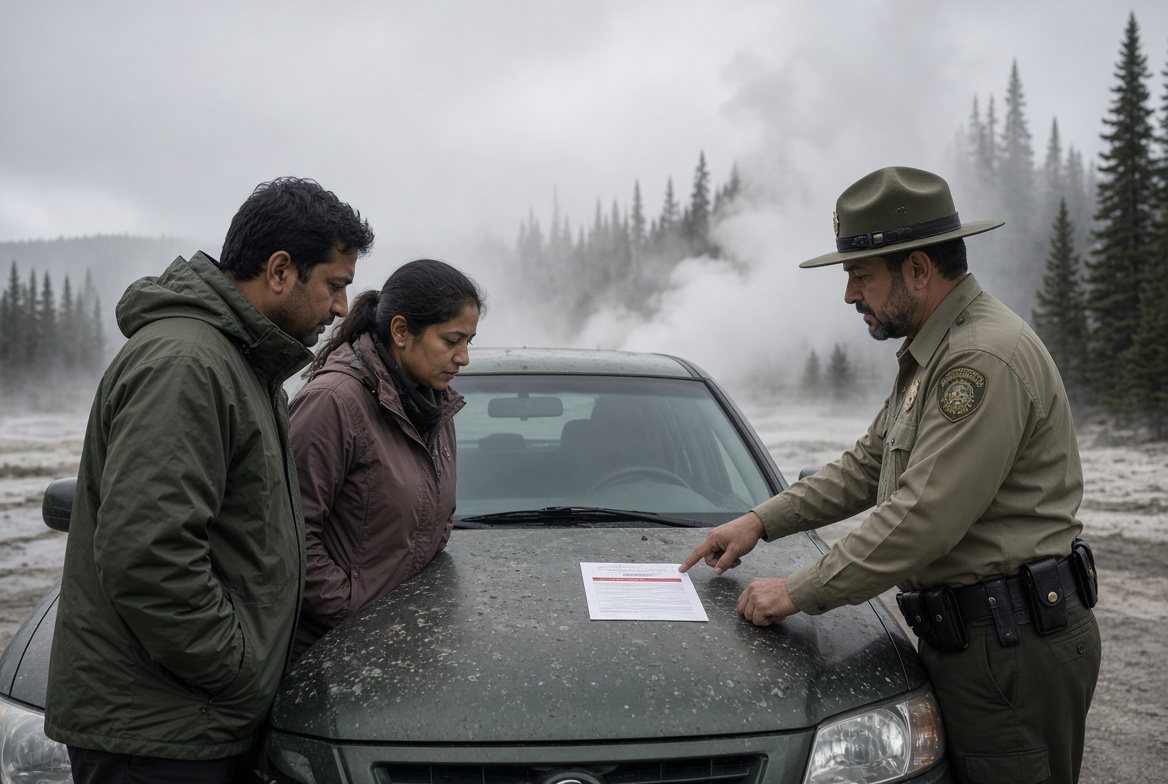
The District of Wyoming's collateral schedule lists foot travel in thermal areas and the canyon as a mandatory appearance. A closure violation by itself is $100 on the same schedule, and damaging a mineral formation is listed at $250 or an appearance. A notice for the thermal count therefore arrives with Box A checked, and the page on reading the notice explains what follows. The case will be called at Mammoth whether or not you do anything, and someone has to answer for you when it is.
Mammoth, Old Faithful, Norris, Midway
The Mammoth terraces sit a short walk from the court that hears the case, and the travertine there keeps a footprint, which is why some Mammoth cases carry a second count for destroying a mineral resource (36 CFR § 2.1(a)(1)(iv)). In 2026 a Texas visitor who left footprints across Canary Spring and three other features drew five days in custody; in 2024 a Colorado man who entered the protected area at Canary Spring with a second adult and two children received seven days, five years of probation with a ban, and a $3,000 fine. At Old Faithful a visitor who walked roughly ten feet out onto the cone, filmed by a stranger, received seven days in 2025. At Norris a twenty-one-year-old who crossed the fence and climbed toward Steamboat Geyser's vent received a week, $1,500, and a two-year ban. At Midway two visitors who walked onto the bacterial mat at Opal Pool were each given two days, $350, $106.92 in restitution, and a two-year ban.
Two places produce notices without a boardwalk in sight. The Grand Prismatic Overlook trail, off the Fairy Falls trail, crosses a hillside above thermal ground: stepping off it toward the spring is charged under the same paragraph as the boardwalks, and where the slope is signed as a revegetation area, a $100 count for leaving the trail (36 CFR § 2.1(b)) comes with it. The canyon rim, from Uncle Tom's to Artist Point and along the North Rim, is named in the same paragraph as the geyser basins. A photograph from a rock beyond the railing is charged exactly like a step off the boardwalk at Norris.
Why the sign still matters
The boardwalks are marked by official signs, as the rule requires, and the edge of the boardwalk is itself the line. The pictogram signs at the basins, the fences at Norris, and the printed warnings the park puts in front of visitors are how the government answers the person who says nobody told him, and the ranger's report will list what was posted at the spot. The charge and the sentence are different questions. A visitor who stepped onto the crust for a picture, was called back, and came back is at one end of the range. A visitor who read the sign, climbed the fence, and argued when the ranger arrived is at the other, and the announced jail sentences live there. What you said in the first minute is in the report. What you did in the thirty seconds before is on someone's phone. Both are evidence of state of mind, and when the act is not in dispute, state of mind is what the disposition turns on.
The video
A large share of these cases begin with a clip a stranger uploaded, and the ranger's report quotes it: the caption, the comments, the time stamp, the distance the poster guessed. If you are the person in the clip, three things follow. Do not respond to it, because a reply is a statement. Do not post your own, because an explanation with a location tag is a confession. And do not delete what you already published: destroying a record in contemplation of a federal matter is its own offense, with a penalty measured in years (18 U.S.C. § 1519). Send me the link and leave the rest alone.
When more than one person stepped off
In the 2024 case at Canary Spring, the two adults who entered the protected area with two children were the two defendants; the children were not charged. Each adult cited has a case in their own name at Mammoth, the government treats the cases as related, and nobody in a group should resolve anything until all of them have talked to a lawyer. Guides are the other version: in 2021 a self-styled guide who promoted off-trail thermal trips in a guidebook and a podcast was tried on fifteen counts, found guilty on seven after a two-day bench trial, and given a week in custody, five years of probation, and an order to rewrite the book's introduction. Nor is the person who is hurt excused. A visitor burned off-trail in 2023 was charged for the walk, with a ban from both parks as a condition of release while the case was pending.
The ban as a condition of probation
A park ban is not a separate sentence; it is a condition of probation. Federal law lets the court place a misdemeanor defendant on probation for up to five years (18 U.S.C. § 3561(c)(2)) and attach conditions reasonably related to the offense, including that the defendant refrain from frequenting specified kinds of places (18 U.S.C. § 3563(b)(6)). In thermal cases the specified place is Yellowstone, the term has run from two years to five, and in the 2016 Grand Prismatic case it covered every acre managed by three federal departments. Entering the park while the condition is in force is a probation violation. A ban is avoidable in many cases and negotiable in most, and it is the term I spend the most time on for anyone who intends to come back.
Restitution and payments
The court can order restitution as a condition of probation (18 U.S.C. § 3563(b)(2)), and it has: $106.92 for the mat at Opal Pool, a figure precise to the cent. More often the judgment includes a community-service payment to the Yellowstone Forever geological fund, $500 to $1,000 in the announced cases, which is neither a fine nor restitution but arrives in the same order. What a conviction does afterward, and how the case is handled without you flying back, have their own pages: whether this is a criminal record, and whether you have to return to Wyoming. The Yellowstone page covers the court itself.
Asked about boardwalk and closed-area cases.
Is walking off the boardwalk in Yellowstone really a crime?
The ranger said I have to appear in court. Can I just pay the ticket instead?
I stepped off for a few seconds and stepped right back. Does that matter?
Someone filmed me and posted it. Can the government use that?
Will I be banned from Yellowstone?
My child stepped off the boardwalk. Am I the one in trouble?
Find your citation.
Every page below is written for one kind of notice. Start with the one that matches yours.
Start with a confidential conversation with Aaron Herzberg.
National-park matters begin with a thirty-minute call, and almost everything after that can be handled from wherever you are. Book it through the chat button in the corner of this page, or send the note here and my office will call you, usually the same business day. Have your violation notice in hand so we can read the box together, and call or text any time. Video consultations are available in Chinese, Korean, Japanese, Spanish, French, German and Italian, with live translation software, on request.
40 E Simpson Ave, Jackson, WY 83001 · by appointment · video consultations for out-of-state clients · info@puzzlegroup.com