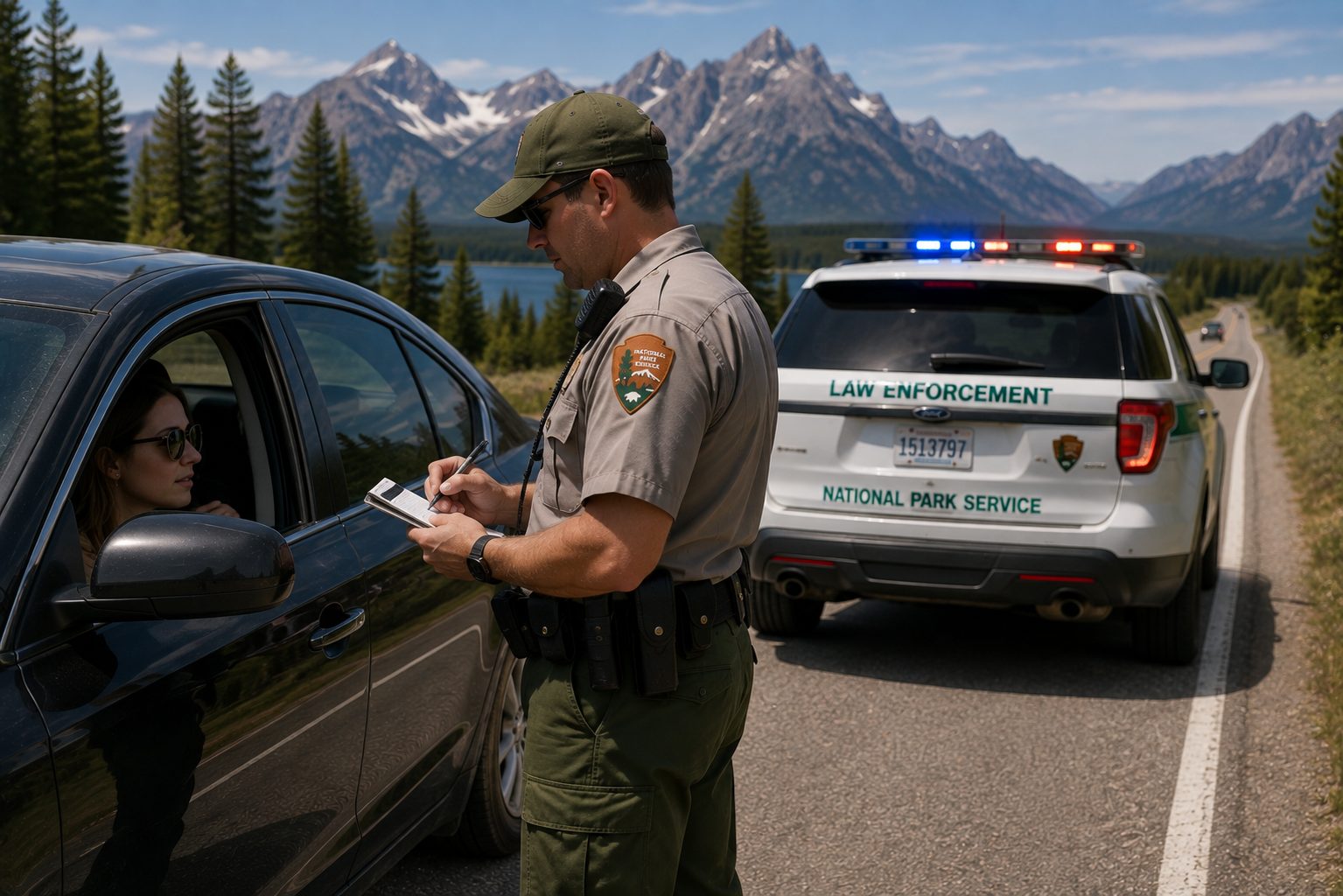
Look up the regulation on your violation notice.
The ranger wrote a number, not a word. This page says what the number prohibits, what the court will take to close the case by mail, whether it can be closed by mail at all, and which page covers it.
Call or text me. Clients get my cell number from day one, and I answer. Got a violation notice? Here's what happens next.
Read it in your language. Talk it through in your language.
Every page of this National Parks chapter is written in Chinese, Korean, Japanese, Spanish, French, German and Italian. The consultation is a video call with attorney Aaron Herzberg, carried in your language by live translation software, at no additional charge.

The number tells you the part.
Federal park charges live in Title 36 of the Code of Federal Regulations, and the first digit is the part. Part 7 holds the rules written for one park only: 7.13 is Yellowstone, 7.22 is Grand Teton.
The section decides what the government has to prove. A second section is often the one that carries the real consequence, and it can change a payable notice into one that requires an appearance.
The collateral amount decides whether the notice has Box B, meaning the case can be closed by mail, or Box A, meaning it cannot. Where a table says Appearance required, there is no amount to pay and the case will be called in court.
Find your section two ways.
Type the number on your notice into the search box, or match its first digits to a part here and jump to that table.
Part 1 — Closures, permits and drones
The general provisions. Anything a superintendent has closed by order lands here, which is why the wildlife distances and the drone ban are charged as closure violations rather than under a rule of their own.
| Section | What it prohibits | Collateral | Read |
|---|---|---|---|
| 1.5(f) | Violating a closure or a use limit | $100 | Off-trail & thermal |
| 1.5(f) | Approaching within 25 yards of wildlife, or 100 yards of a bear, wolf or cougar | $100 | Wildlife |
| 1.5(f) | Drone, minor | $400 | Chapter hub |
| 1.5(f) | Drone, major | Appearance required | Chapter hub |
| 1.6(g)(1) | An activity that requires a permit, without one | $200 | Chapter hub |
| 1.6(g)(2) | Violating the terms and conditions of a permit | $100 | Chapter hub |
Part 2 — Resources, plants and the ground itself
The resource-protection rules. Two of them, the rock thrown into a hot spring and the shortcut across a switchback, are the ones visitors are surprised to be cited under.
| Section | What it prohibits | Collateral | Read |
|---|---|---|---|
| 2.1(a)(1)(i) | Possessing, destroying or injuring wildlife or fish, or any part of one | Appearance required | Wildlife |
| 2.1(a)(1)(ii) | Possessing or destroying plants or parts of them | $100 | Off-trail & thermal |
| 2.1(a)(1)(iii) | Fossils or cultural resources | $500 or appearance | Chapter hub |
| 2.1(a)(1)(iv) | A mineral resource or cave formation | $250 or appearance | Chapter hub |
| 2.1(a)(3) | Throwing rocks or objects into a thermal feature, cave or valley | $250 or appearance | Off-trail & thermal |
| 2.1(a)(4) | Using or possessing illegal wood | $150 | Chapter hub |
| 2.1(a)(5) | Walking on an archeological or resource area | $150 | Off-trail & thermal |
| 2.1(a)(7) | Possessing or using a metal detector | $250 | Chapter hub |
| 2.1(b) | Leaving the trail to shortcut a switchback | $100 | Off-trail & thermal |
| 2.1(c)(3)(iii) | Removing natural products from the park | $150 plus $25 each | Chapter hub |
Part 2 — Wildlife
Note which of these can be paid and which cannot. The distance rules are closures, at $100. Touching, feeding or disturbing the animal is this section, and it is an appearance every time.
| Section | What it prohibits | Collateral | Read |
|---|---|---|---|
| 2.2(a)(1) | Taking wildlife, meaning hunting where it is not authorized | Appearance required | Wildlife |
| 2.2(a)(2) | Feeding, touching, teasing, frightening or intentionally disturbing wildlife | Appearance required | Wildlife |
| 2.2(a)(2) | Using bugles or game calls | $200 | Wildlife |
| 2.2(a)(3) | Possessing unlawfully taken wildlife | Appearance required | Wildlife |
| 2.2(e) | Using artificial light to view wildlife | $150 | Wildlife |
Part 2 — Fishing
A state license is worth nothing inside either park. Yellowstone and Grand Teton each add their own rules further down this page.
| Section | What it prohibits | Collateral | Read |
|---|---|---|---|
| 2.3(d)(1) | Improper method, or an unattended line | $100 | Chapter hub |
| 2.3(d)(2) | Possessing or using improper bait | $100 | Chapter hub |
| 2.3(d)(4) | Commercial fishing | Appearance required | Chapter hub |
| 2.3(d)(7) | Improper catch and release | $150 plus $20 a fish | Chapter hub |
| 2.3(d)(8) | Fishing from a bridge or dock | $100 | Chapter hub |
Part 2 — Weapons
Carrying a firearm into either park is governed by state law, but carrying one into a federal building inside the park is not, and neither is using one.
| Section | What it prohibits | Collateral | Read |
|---|---|---|---|
| 2.4(b)(1)(i) | Possessing a weapon, trap or net | $150 | Chapter hub |
| 2.4(c) | Carrying a loaded weapon in a vehicle | $150 | Chapter hub |
| 2.4(d) | Using a weapon in a way that endangers persons or property | Appearance required | Chapter hub |
Part 2 — Camping, fires and food
The campground charges. Food storage is the one that turns serious: stored badly where a bear or a wolf got into it, the notice cannot be paid.
| Section | What it prohibits | Collateral | Read |
|---|---|---|---|
| 2.10(b)(2) | Leaving equipment or refuse behind at a site | $100 | Chapter hub |
| 2.10(b)(4) | Violating quiet hours | $50 | Chapter hub |
| 2.10(b)(8) | Camping without the required permit | $100 | Chapter hub |
| 2.10(b)(10) | Camping outside a designated site | $100 | Chapter hub |
| 2.10(d) | Improper food storage, minor | $100 | Chapter hub |
| 2.10(d) | Improper food storage where a bear or wolf was involved | Appearance required | Chapter hub |
| 2.12(a)(1)(ii) | Unreasonable noise from motorized equipment | $100 | Chapter hub |
| 2.13(a)(1) | A fire outside a designated area | $200 | Chapter hub |
| 2.13(a)(3) | A fire threatening or causing damage | $200 | Chapter hub |
| 2.13(a)(4) | Leaving a fire unattended | $200 | Chapter hub |
| 2.13(b) | Failing to extinguish a fire properly | $200 | Chapter hub |
| 2.13(c) | Building a fire during high fire danger | $200 | Chapter hub |
| 2.14(a)(1) | Littering | $200 | Chapter hub |
| 2.14(a)(6) | Polluting or contaminating park water | $250 or appearance | Chapter hub |
| 2.14(a)(8) | Disposing of human waste in a developed area | $150 | Chapter hub |
Part 2 — Pets and the rest of Part 2
Yellowstone's own dog rule, at 7.13(h) below, is stricter than the general one and is what a visitor in that park is usually cited under.
| Section | What it prohibits | Collateral | Read |
|---|---|---|---|
| 2.15(a)(1) | A pet in a public building, front country | $50 | Chapter hub |
| 2.15(a)(1) | A pet in a public building, back country | $100 | Chapter hub |
| 2.15(a)(2) | Failing to confine or leash a pet | $50 | Chapter hub |
| 2.15(a)(3) | Leaving a pet unattended and tied | $50 | Chapter hub |
| 2.15(c) | An animal running at large | $50 | Chapter hub |
| 2.18(c) | A snowmobile in an undesignated area | Appearance required | Yellowstone |
| 2.19(a) | Skiing or snowshoeing on a park road | $50 | Chapter hub |
| 2.21 | Smoking in an undesignated area | $50 | Chapter hub |
| 2.22(a)(2) | Property left unattended more than 24 hours | $50 | Chapter hub |
| 2.23(b) | Failing to pay a recreation fee | $200 | Chapter hub |
| 2.36 | Gambling | $50 | Chapter hub |
| 2.38(a) | Explosives | Appearance required | Chapter hub |
| 2.38(b) | Fireworks | $250 to use, $100 to possess | Chapter hub |
| 2.51(a) | A public assembly without a permit | $100 | Chapter hub |
| 2.52(a) | Distributing printed matter without a permit | $100 | Chapter hub |
| 2.61(a) | Residing on park land without a permit | $150 | Chapter hub |
| 2.62(b) | Scattering human ashes without a permit | $50 | Chapter hub |
Part 2 — Property, conduct and rangers
What is said to the ranger sits in this block. A false report is its own $250 offense, and it is the charge that does more damage to an immigration file than the ticket it was said about.
| Section | What it prohibits | Collateral | Read |
|---|---|---|---|
| 2.30(a)(2) | Obtaining property or services without paying | Appearance required | Yellowstone |
| 2.31(a)(1) | Trespass on property not open to the public | $200 | Yellowstone |
| 2.31(a)(2) | Tampering with property | $150 | Yellowstone |
| 2.31(a)(3) | Destroying, injuring, defacing or damaging property | $250 or appearance | Yellowstone |
| 2.31(a)(4) | Harassment with physical contact | Appearance required | Yellowstone |
| 2.31(a)(5) | Obstructing a trail, sidewalk or highway | $200 | Yellowstone |
| 2.32(a) | Threatening, resisting, intimidating or interfering with a government employee | $250 or appearance | Yellowstone |
| 2.32(a)(2) | Violating a lawful order, including at a wildlife jam | $250 or appearance | Wildlife |
| 2.32(a)(3)(i) | Knowingly giving false information | $250 | Yellowstone |
| 2.32(a)(4) | A false report made to mislead a government employee | $250 | Yellowstone |
| 2.33(b) | Failing to report an incident causing more than $300 of damage | $150 | Unsafe operation |
| 2.34(a)(1) | Fighting, threatening or violent behavior | $200 | Yellowstone |
| 2.34(a)(2) | Obscene language, utterance or gesture | $150 | Yellowstone |
| 2.34(a)(3) | Making unreasonable noise | $200 | Yellowstone |
| 2.34(a)(4) | Creating a hazardous or physically offensive condition | $150 | Yellowstone |
Part 2 — Alcohol and controlled substances
The block that does the most damage per dollar. Every figure here is small and every one of them is a federal drug or alcohol disposition if it is paid.
| Section | What it prohibits | Collateral | Read |
|---|---|---|---|
| 2.35(a)(2)(i) | Sale or gift of alcohol to a person under 21 | Appearance required | Alcohol |
| 2.35(a)(2)(ii) | Possession of alcohol by a person under 21 | $100 | Alcohol |
| 2.35(a)(3)(iii) | Alcohol in an area closed to it | $100 | Alcohol |
| 2.35(b)(1) | Delivery of a controlled substance | Appearance required | Marijuana & drugs |
| 2.35(b)(2) | Possession of marijuana, minor amount | $400 | Marijuana & drugs |
| 2.35(b)(2) | Possession of any other controlled substance | Appearance required | Marijuana & drugs |
| 2.35(c) | Being in the park under the influence to a degree that may endanger | $250 | Alcohol |
Part 3 — Boating and water
A vessel is any watercraft, so the raft on the Snake and the kayak on Jackson Lake are in this part. There is no open-container rule for vessels; there is a rule about who is on the oars.
| Section | What it prohibits | Collateral | Read |
|---|---|---|---|
| 3.3 | Vessel permit violation, non-motorized | $100 | Grand Teton |
| 3.3 | Vessel permit violation, motorized | $200 | Grand Teton |
| 3.5(a)(1) | Failing to report a boating accident with $2,000 or more of damage | $200 | Grand Teton |
| 3.5(a)(2) | Failing to report a boating accident with injury or death | $250 | Grand Teton |
| 3.6(a)(1) | An operator under 16 on a power vessel | $75 | Grand Teton |
| 3.8(a)(2) | Launching or recovering at an undesignated site | $75 | Grand Teton |
| 3.8(b)(3) | Exceeding flat-wake speed | $75 | Grand Teton |
| 3.8(b)(8) | Operating a vessel negligently | Appearance required | Grand Teton |
| 3.8(b)(9) | Operating a vessel grossly negligently | Appearance required | Grand Teton |
| 3.9(a) | A personal watercraft in an unauthorized area | $75 | Grand Teton |
| 3.10(a)(1) | Operating a vessel under the influence | Appearance required | Alcohol |
| 3.10(a)(2) | Operating a vessel at 0.08 or more | Appearance required | Alcohol |
| 3.11(a)(1) | Refusing a chemical test on the water | Appearance required | Alcohol |
| 3.13(a) | Discharging sewage from a vessel | Appearance required | Grand Teton |
| 3.17(a) | Swimming in a closed area | $100 | Grand Teton |
| 33 CFR 175.15(a) | No wearable flotation device for each person, adopted by 36 CFR 3.2 | $100 | Grand Teton |
Part 4 — Driving
The volume charges. Read the amount against the arithmetic: speeding is $10 a mile, so a figure that does not divide by ten was probably written under 4.22 instead, which is a different case.
| Section | What it prohibits | Collateral | Read |
|---|---|---|---|
| 4.2(a), (b) | State traffic law, adopted into the regulations. Reckless driving under W.S. 31-5-229 arrives through here | No collateral line; appearance | Unsafe operation |
| 4.4(a), (c) | Not reporting an accident within 24 hours | $200 | Unsafe operation |
| 4.4(b) | Towing or moving a vehicle from an accident without notifying the park | $200 | Unsafe operation |
| 4.10(a) | Driving in a prohibited area, under 100 feet, no damage | $100 | Driving off-road |
| 4.10(a) | Driving in a prohibited area, over 100 feet or with damage | Appearance required | Driving off-road |
| 4.11(b)(2) | An oversize or overweight vehicle without a permit | $400 | Chapter hub |
| 4.12 | Failing to comply with a traffic control device | $60 minor, $150 major | Unsafe operation |
| 4.13(a) | Stopping or parking on the roadway, which is the wildlife jam | $100 | Wildlife |
| 4.13(b) | Driving so slowly as to interfere with traffic | $100 | Unsafe operation |
| 4.14(b) | Carrying or storing an open container of alcohol | $100 | Alcohol |
| 4.14(d) | An open container readily available, including the glove box | $100 | Alcohol |
| 4.15(a) | Occupants not wearing seat belts | $50 each | Unsafe operation |
| 4.20 | Failing to yield the right of way | $100 | Unsafe operation |
| 4.21(c) | Speeding | $10 for every mph over | Speeding |
| 4.21(c) | Speeding 30 or more over the limit | Appearance required | Speeding |
| 4.21(c) | Speeding in a construction zone | $15 for every mph over | Speeding |
| 4.21(c) | Construction zone, 25 or more over | Appearance required | Speeding |
| 4.22(b)(1) | Operating without due care, or at a speed not reasonable and prudent for conditions | $250 | Unsafe operation |
| 4.22(b)(2) | Causing tires to squeal, skid or break free | $100 | Unsafe operation |
| 4.22(b)(3) | Failing to maintain the control needed to avoid danger | $100 | Unsafe operation |
| 4.22(b)(4)(i) | Allowing a person to ride in a towed vehicle | $100 | Unsafe operation |
| 4.22(b)(4)(ii) | Allowing a person on the exterior of a vehicle | $100 | Unsafe operation |
| 4.23(a)(1) | Driving under the influence of alcohol or drugs | Appearance required | DUI |
| 4.23(a)(2) | Driving at an alcohol concentration of 0.08 or more | Appearance required | DUI |
| 4.23(c)(2) | Refusing the breath test | Appearance required | DUI |
| 4.30(h)(1) | A bicycle off a designated route | $75 | Chapter hub |
| 4.30(h)(5) | Riding a bicycle while drinking | $100 | Alcohol |
| 4.30(i)(2) | An e-bike where they are prohibited | $75 | Chapter hub |
| 4.30(i)(4) | An e-bike in a wilderness area | Appearance required | Chapter hub |
| 4.31 | Hitchhiking or soliciting transportation | $25 | Chapter hub |
Part 5 and Part 71 — Commercial activity and park passes
Nearly every line in Part 5 is an appearance. Guides, photographers and film crews working without the right permit are charged here, and so is the visitor whose paid trip turned out to be unpermitted.
| Section | What it prohibits | Collateral | Read |
|---|---|---|---|
| 5.3 | Business operations without a permit | Appearance required | Chapter hub |
| 5.4(a) | Commercial passenger transportation | Appearance required | Chapter hub |
| 5.5(a) | Filming without a permit | Appearance required | Chapter hub |
| 5.5(b) | Still photography for commercial advertising | Appearance required | Chapter hub |
| 5.6(b) | Unauthorized use of government roads | $400 | Chapter hub |
| 71.8(b) | Misusing a non-transferable park pass | $100 | Chapter hub |
| 71.8(c) | Failing to show a pass on demand | $75 | Chapter hub |
Part 7 — Yellowstone only (§ 7.13)
The special regulations written for this park alone. The boardwalk rule is here, and so is the rule against getting into a hot spring, which is the charge people do not know exists.
| Section | What it prohibits | Collateral | Read |
|---|---|---|---|
| 7.13(a)(2) | Transporting hazardous materials on U.S. 191 | $330 | Yellowstone |
| 7.13(e)(2), (e)(4) | Fishing without a Yellowstone permit | $200 | Yellowstone |
| 7.13(e)(4) | Fishing closed waters, cutthroat | $100 plus $20 a fish, up to five | Yellowstone |
| 7.13(e)(4) | Fishing closed waters, more than five fish | Appearance required | Yellowstone |
| 7.13(g)(1) | Camping more than 30 days | $100 | Yellowstone |
| 7.13(h) | A dog off leash within 100 feet of a road | $50 | Yellowstone |
| 7.13(h) | A dog more than 100 feet from a road | $100 | Yellowstone |
| 7.13(h) | A dog in the back country | $200 | Yellowstone |
| 7.13(j) | Foot travel off the boardwalks or marked trails in a thermal area | Appearance required | Off-trail & thermal |
| 7.13(k) | Portable engines, motors or chain saws | $100 | Yellowstone |
| 7.13(l)(9)(i) | A recreational snowmobile without a guide | Appearance required | Yellowstone |
| 7.13(l)(13)(i)(D) | Reckless operation of an oversnow vehicle | Appearance required | Yellowstone |
| 7.13(l)(14)(i) | An oversnow driver under 21 at 0.02 or more | Appearance required | DUI |
| 7.13(l)(14)(ii) | A guide or oversnow driver at 0.04 or more | Appearance required | DUI |
| 7.13(m) | Swimming or soaking in a natural or thermal pool | Appearance required | Off-trail & thermal |
Part 7 — Grand Teton only (§ 7.22)
Grand Teton's own regulations run to fishing, camping and the water. Everything else that happens in the park is charged under the general rules above.
| Section | What it prohibits | Collateral | Read |
|---|---|---|---|
| 7.22(b)(1) | Fishing in a closed area | $75 | Grand Teton |
| 7.22(b)(2) | Fishing from a bridge or dock | $100 | Grand Teton |
| 7.22(b)(3) | Using unlawful bait | $100 | Grand Teton |
| 7.22(d)(1) | Camping more than 30 days in a year | $100 | Grand Teton |
| 7.22(d)(2) | More than six people at a campsite | $75 | Grand Teton |
| 7.22(e)(1) | A motorboat in an unauthorized area | $75 | Grand Teton |
| 7.22(e)(3) | A hand-propelled vessel in an unauthorized area | $75 | Grand Teton |
| 7.22(e)(5) | Mooring or beaching without authorization | $75 | Grand Teton |
| 7.22(g)(11)(i)(D) | Reckless operation of an oversnow vehicle | Appearance required | Grand Teton |
Nothing matches that. Try the bare section number, without the paragraph letters, or a plain word like fire, dog or speed.
Sections and amounts from the District of Wyoming collateral fine schedule for the National Park Service, as amended by general order of April 14, 2022, and from Title 36 of the Code of Federal Regulations. A $30 processing fee is added to the collateral figure. Rule citations are to L.Cr.R. 58.2 as amended in 2026 (the court's current compilation is dated August 1, 2026). The court revises the schedule from time to time and a ranger may require an appearance on any notice, so the box and the amount on your own notice control. Selected entries: rules directed at concessioners, operators and vehicle emissions standards are left out.
What paying does, and what it does not.
The amount on a Box B notice is called collateral. If Box B is checked, paying the required collateral resolves the case without an appearance. And under its 2026 revision, the United States District Court for the District of Wyoming, the federal court for Yellowstone and Grand Teton National Parks, spells out in its own rules exactly what that means: payment resolves the case without an admission of liability or an adjudication of guilt. It is not a fine. For a traffic violation, the disposition is not reported to a state or tribal government. L.Cr.R. 58.2(c)(5).
In other words, collateral forfeiture under the federal court's rule is not a conviction. And because a traffic collateral disposition is not reported to the state, it is not transmitted to the state DMV for assessment of points. The national Central Violations Bureau materials contain broader warnings about the possible consequences of paying a federal ticket, but those materials cover federal courts nationwide; the United States District Court for the District of Wyoming has expressly defined the effect of collateral payment in this district.
Two limits on that. The protection attaches to paying, not to ignoring the notice: if you neither pay nor appear, the court may report the failure to your state's motor-vehicle agency, with consequences that can include the inability to renew a license or registration (L.Cr.R. 58.2(e)). And only offenses on the court's collateral schedule can be paid at all; a notice with Box A checked cannot be closed by payment, however much you send.
Two things are important. First, payment resolves the case. Once it is paid, you give up the opportunity to seek a dismissal or another negotiated disposition. That distinction can matter to someone who later must answer detailed questions about citations, charges, immigration history, professional licensing, or security clearances.
Second, collateral payment is very different from pleading guilty or being convicted after trial. The federal court's rule expressly states that a conviction at trial is an adjudication of guilt. Most ordinary National Park Service regulatory offenses carry a statutory maximum of six months in jail and, for an individual, up to a $5,000 fine. That makes them Class B misdemeanors. The records page explains who can see a payment, who can see a conviction, and who asks about both.
About the number itself.
What does 36 CFR mean on my ticket?
The section on my notice is not on this list.
My notice cites two regulations. Does that change anything?
The amount on my notice does not match this page.
It says appearance required and I have gone home.
Can I just pay the smallest ones?
Find your citation.
One page per kind of notice. Start with the one that matches yours.
Start with a confidential conversation with Aaron Herzberg.
National-park matters begin with a thirty-minute call, and almost everything after that can be handled from wherever you are. Book it through the chat button in the corner of this page, or send the note here and my office will call you, usually the same business day. Have your violation notice in hand so we can read the box together, and call or text any time. Video consultations are available in Chinese, Korean, Japanese, Spanish, French, German and Italian, with live translation software, on request.
40 E Simpson Ave, Jackson, WY 83001 · by appointment · video consultations for out-of-state clients · info@puzzlegroup.com