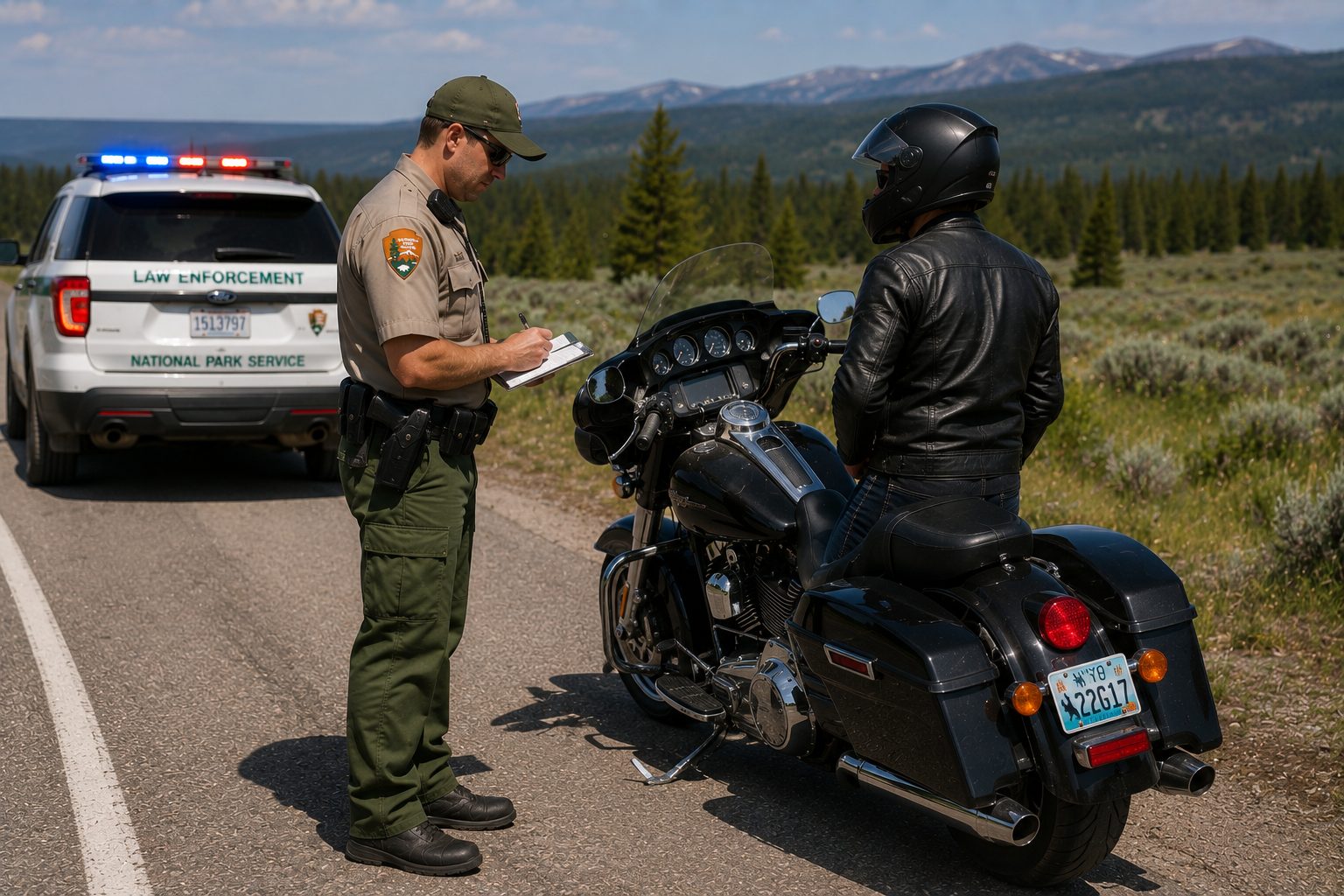
Speeding tickets in Yellowstone and Grand Teton National Park.
Sixty-one in a forty-five on the Grand Loop. Sixty-eight on the highway through Grand Teton, where the limit is fifty-five and the road was built for more. For most people a park speeding notice is a small problem, and I will say so on this page. For some it is not, and the difference is not the speed.
Call or text me. Clients get my cell number from day one, and I answer. Got a violation notice? Here's what happens next.
Read it in your language. Talk it through in your language.
Every page of this National Parks chapter is written in Chinese, Korean, Japanese, Spanish, French, German and Italian. The consultation is a video call with attorney Aaron Herzberg, carried in your language by live translation software, at no additional charge.

What the regulation says, and how a ranger proves it.
The charging paragraph is one sentence: operating a vehicle at a speed in excess of the speed limit is prohibited (36 CFR § 4.21(c)). The government proves the limit that applied where you were and the speed you were going, and little else.
The regulation sets three limits of its own: fifteen miles per hour in campgrounds, picnic and parking areas, business and residential areas, and at emergency scenes; twenty-five where a road is under repair; and forty-five on every other park road (36 CFR § 4.21(a)). A superintendent may post something different, and both do.
The regulation lets an authorized person use "radiomicrowaves or other electrical devices" to measure speed and says no warning signs are required (36 CFR § 4.21(d)). "I know, I was going a little fast" is an admission, which is why polite and brief is the right amount to say.
When to pay, and when not to.
A good many park speeding notices should simply be paid. If you were eight over on the Grand Loop, you hold an ordinary license, nobody runs background checks on you for a living, you are a citizen, and the notice cites § 4.21(c) with Box B checked, then paying $110 ends the matter as a forfeiture: not a conviction, not a fine, and not reported to your state under the federal court's rule. What you give up is the chance of a dismissal, and for a small speeding notice most people can live with that; I will tell you so on the phone. The page on what happens if you just pay goes through it.
The people who should not pay before a short conversation usually know who they are. Commercial drivers, because federal motor-carrier rules count even a paid forfeiture as a conviction for a moving violation (49 CFR § 383.5), which must be reported to the employer and can count toward disqualification. Clearance holders and licensed professionals, because the question is never the ticket but the disclosure, and the page on records explains what a paid notice is and is not, and who still has to disclose it. Non-citizens, because an officer reviewing a visa or green-card application reads a federal disposition on its own terms; the immigration page covers when that matters. Anyone whose notice shows a second regulation, an amount that does not fit the arithmetic, or Box A, because those are not speeding tickets any more; they are cases.
- 01Five over: $50, plus the $30 processing fee, $80 in all
- 02Ten over: $100 plus $30, $130
- 03Twenty over: $200 plus $30, $230
- 04Twenty-nine over: $290 plus $30, $320, the highest amount on the schedule
- 05Thirty or more over: no amount to pay; Box A, and a mandatory appearance before the magistrate judge
- 06Construction zone: $15 a mile, so ten over is $180 and twenty over is $330; twenty-five or more over is a mandatory appearance
Rates from the District of Wyoming's collateral fine schedule for the National Park Service (amended April 2022); the $30 processing fee as stated in U.S. Attorney's Office sentencing announcements. Collateral is what ends the case if you pay it by mail. It is not a sentence, and after an appearance the court can impose more, or something other than money.
Your state record, and the roads.
What goes home to your state, the collateral, the highway and the loop, the second charge
What goes home to your state, and what your insurer sees
The Central Violations Bureau says on its own site that it "reports paid violation notices for moving offenses (e.g. speeding or running a stop sign) to the driver's state of record for many jurisdictions." Yellowstone and Grand Teton are not among them. Under the federal court's rule as amended in 2026, a paid traffic notice "shall not be reported to a State or tribal government" (L.Cr.R. 58.2(c)(5)), so a paid Box B speeding notice is not transmitted to your state's motor-vehicle agency for assessment of points. The Bureau's national language describes what other districts do; this district has decided the question for itself, and the protection attaches to paying, not to ignoring the notice (58.2(e)).
So "will this go on my record" has a two-part answer. The federal part: a paid notice is a forfeiture of collateral in the Bureau's file, not a conviction, and it does not ordinarily appear as a case on the court's public docket. The state part: nothing is sent, so there is nothing for your state to post. Two exceptions. A conviction after a plea or a trial is different, because the rule lets the court report a driving conviction to your state, and what your state does with it is a matter of fifty different statutes. And a commercial driver is different, because federal motor-carrier rules count a paid forfeiture as a conviction for a moving violation (49 CFR § 383.5), whatever the court reports. What an insurer sees is a question about your state's record and your policy, not about this court; I do not advise on coverage.
The collateral, and the amount that does not fit
The District of Wyoming's collateral schedule for Park Service cases prices speeding at ten dollars for every mile over the posted limit, makes thirty or more over a mandatory appearance, and in construction zones raises the rate to fifteen dollars a mile with the appearance line at twenty-five over. A thirty-dollar processing fee is added to reach the total collateral due printed on the notice. The collateral is not a fine imposed by a judge; it is the fixed sum the court accepts in place of your appearance for an offense on its schedule (L.Cr.R. 58.2(c)), and the maximum on conviction remains six months and $5,000, which nobody receives for speeding and which nonetheless defines the class of the offense. Forty-nine in a forty-five should read $40 plus the fee. A notice for the same speed that reads $280 was written under § 4.22(b)(1), a speed greater than reasonable and prudent for the conditions, which carries a flat $250 whatever the number and has a page of its own.
Grand Teton's highway
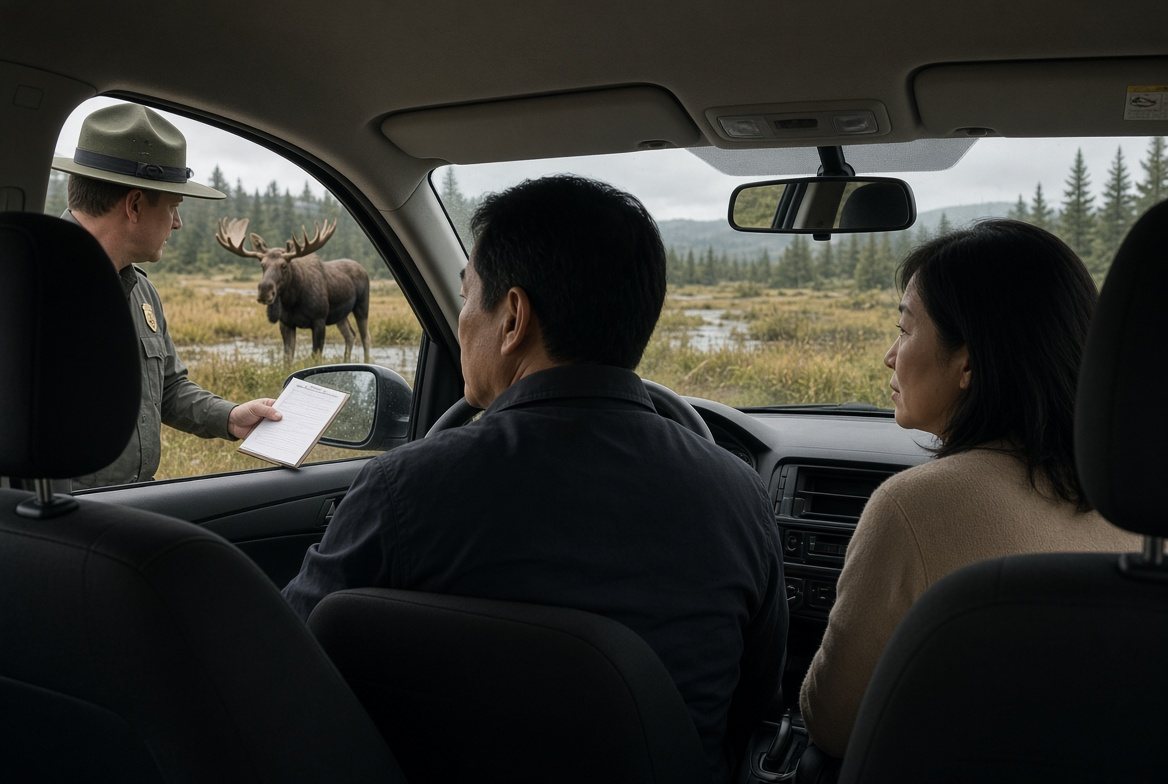
U.S. 26/89/191 is the reason this page exists. It runs north from Jackson through the park at a posted fifty-five, on a road engineered for more, with the range filling the windshield; the Grand Teton page explains why that highway is the park and not a state road. Fifty-five feels slow on it, sixty-five feels normal, and through Moose Alley, where the limit falls to forty-five by posting, a driver holding sixty-five is twenty over. After dark the highways are posted at forty-five, when the elk and moose are on the pavement, and a driver holding the daytime fifty-five is ten over without having changed anything. Teton Park Road carries posted twenty-fives and thirties through the developed stretches and forty-five between them.
Yellowstone's loop
The Grand Loop is forty-five nearly everywhere, and the open stretches through Hayden Valley and along the Madison make sixty feel like nothing. The developed areas at Old Faithful, Canyon, and Mammoth are posted lower, and the regulation's own fifteen applies in every parking area and business district. Then there are the animal jams. Stopping in the road to photograph a bison is its own offense, obstructing traffic (36 CFR § 4.13(a)), at $100, and a wildlife strike at highway speed is how a speeding case turns into a crash case.
The second charge
High speeds seldom travel alone. Thirty over, a pass on a double yellow, or any speed with wildlife or weather in the report invites a second citation under § 4.22: operating without due care or at a speed greater than reasonable and prudent "considering wildlife, traffic, weather, road and light conditions and road character," at $250, or failing to maintain control, at $100. The regulation calls those offenses "less serious than reckless driving," and reckless driving proper comes into the parks through Wyoming law. The page on reckless, careless and unsafe operation owns that subject. Here it is enough to say that a speeding notice with a second regulation on it should not be paid as a speeding notice.
Asked about park speeding tickets.
How much is a speeding ticket in Yellowstone or Grand Teton?
Can I just pay a Yellowstone speeding ticket online and be done?
Will a national park speeding ticket go on my driving record?
Does a park speeding ticket affect my insurance?
I live in Texas, or Utah, or Ontario. Do I have to fly back for a speeding ticket?
I was going thirty over. What happens now?
Find your citation.
Every page below is written for one kind of notice. Start with the one that matches yours.
Start with a confidential conversation with Aaron Herzberg.
National-park matters begin with a thirty-minute call, and almost everything after that can be handled from wherever you are. Book it through the chat button in the corner of this page, or send the note here and my office will call you, usually the same business day. Have your violation notice in hand so we can read the box together, and call or text any time. Video consultations are available in Chinese, Korean, Japanese, Spanish, French, German and Italian, with live translation software, on request.
40 E Simpson Ave, Jackson, WY 83001 · by appointment · video consultations for out-of-state clients · info@puzzlegroup.com