
Reckless driving and unsafe operation in Yellowstone and Grand Teton.
The elk stepped out at dusk north of Moose, or the motorhome drifted onto the soft shoulder climbing to Dunraven Pass. The ranger took the report and then handed you a notice for unsafe operation, which reads as if you had done something reckless. Usually you had not, and the regulation says so in its first sentence.
Call or text me. Clients get my cell number from day one, and I answer. Got a violation notice? Here's what happens next.
Read it in your language. Talk it through in your language.
Every page of this National Parks chapter is written in Chinese, Korean, Japanese, Spanish, French, German and Italian. The consultation is a video call with attorney Aaron Herzberg, carried in your language by live translation software, at no additional charge.

What the regulation charges.
The section defines itself downward before it prohibits anything: "The elements of this section constitute offenses that are less serious than reckless driving" (36 CFR § 4.22(a)). It then lists four. The crash cases live in (b)(1) and (b)(3).
"Failing to maintain that degree of control of a motor vehicle necessary to avoid danger to persons, property or wildlife" (§ 4.22(b)(3)) requires no other car, no injury, no speed, no intent. The crash is the proof.
The operator of a vehicle in an accident "resulting in property damage, personal injury or death shall report the accident to the superintendent as soon as practicable, but within 24 hours" (36 CFR § 4.4(a)). Report the crash. Then stop narrating.
Where reckless driving comes from.
The Park Service regulations never define reckless driving, because § 4.2 provides that "unless specifically addressed by regulations in this chapter, traffic and the use of vehicles within a park area are governed by State law," adopts that law as part of the regulations, and makes violating it prohibited (36 CFR § 4.2(a), (b)). In the Wyoming parks that is Wyoming's one-sentence statute: "Any person who drives any vehicle in willful or wanton disregard for the safety of persons or property is guilty of reckless driving" (W.S. § 31-5-229).
- 01Operating without due care, or at a speed not reasonable and prudent for conditions (§ 4.22(b)(1)): $250 collateral
- 02Failing to maintain the control needed to avoid danger to persons, property or wildlife (§ 4.22(b)(3)): $100
- 03Not reporting an accident with property damage within 24 hours (§ 4.4(a), (c)): $200
- 04Towing or moving a vehicle from an accident without notifying the park (§ 4.4(b)): $200
- 05Speeding, where the report has a measured speed (§ 4.21(c)): $10 a mile; thirty over is an appearance
- 06Reckless driving, through Wyoming law (§ 4.2 and W.S. § 31-5-229): no collateral line; an appearance
Collateral amounts as the District of Wyoming's April 2022 schedule lists them for Park Service cases, before the $30 processing fee. A crash with alcohol in it is a DUI case, and the DUI page owns it.
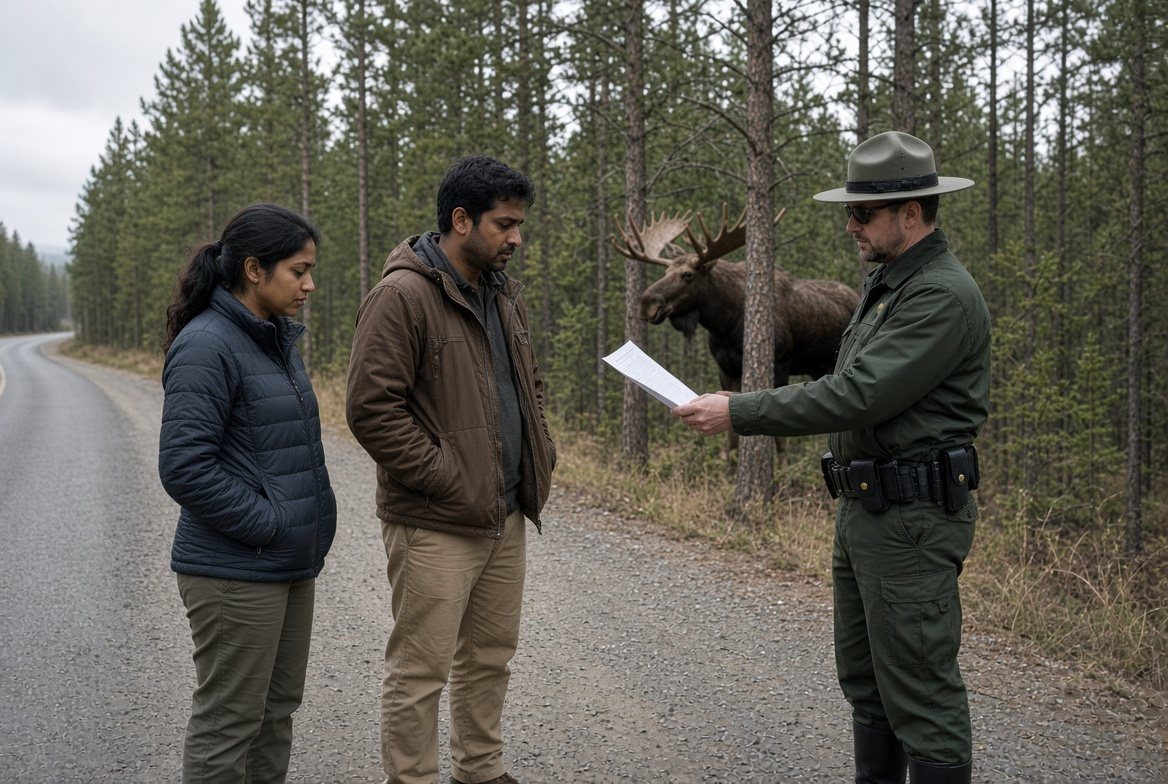
The animal, the report, and the outlier.
Avoiding an animal, the reporting rule, insurance, and the 127-mile-per-hour case
"I was avoiding an animal" is a fact, not a defense
The regulation does not make hitting or swerving for an animal an offense, and it does not excuse it either. It asks whether you were driving with due care "considering wildlife," and whether you kept the control needed "to avoid danger to persons, property or wildlife." Wildlife is written into both halves of the standard. In a park where elk cross the highway at dusk and bison stand in the road through Hayden Valley, an animal in the road is the condition the regulation expects you to have driven for, not a surprise that excuses the result.
So the question in an animal case is never whether the animal was there. It is the speed for the light and the place, the signs you had passed, what the report says you told the ranger, and whether the swerve or the braking was a reasonable response or the thing that put the vehicle in the ditch. A driver at forty at dusk in a posted forty-five who lost a headlight to a moose usually has a good case. A driver at sixty-five on a nighttime forty-five who killed an elk usually does not, however sudden it felt. The same analysis applies to weather: wet pavement is a condition, and the regulation asks what a prudent driver does about it.
For a (b)(1) or (b)(3) notice with no injury, no alcohol, and a crash that was reported, the aim is the one the chapter is built around, a forfeiture, not a conviction, and it is usually a realistic aim. Most of the people who receive one have gone home by the time the case is heard; the page on appearing from home covers what written consent allows.
The reporting rule, and Wyoming's
A vehicle involved in an accident may not be towed or moved "without first notifying the superintendent" unless it is a hazard or notice is not practicable, in which case notice must be given before the vehicle leaves the park (§ 4.4(b)). Failing either is its own offense, at $200 apiece. None of this displaces state law, and Wyoming's is stricter: a driver in an accident with injury or death who fails to stop and remain faces up to a year and $5,000 (W.S. § 31-5-1101), leaving an accident with damage to another attended vehicle or property is a misdemeanor (§ 31-5-1102), and every driver owes the other party a name, an address, a registration number, and reasonable aid.
In practice: a wildlife strike damages your vehicle, which is property, so it is reportable. Call park dispatch or flag a ranger, give the who, where, and when, and leave the animal where it lies, because possessing wildlife is a separate charge under § 2.1(a)(1).
Insurance and the crash report
The ranger's accident report is the official record of the crash, your insurer will ask for it, and it carries the citation, the ranger's opinion of cause, and any statement you made. I do not advise on coverage; what I can say is that the report and the notice travel together, that a recorded statement to an adjuster is a statement and statements travel, and that a dismissal or an amended charge is a document you can send along afterward. Give your insurer the notice of loss it needs. Give the recorded statement after you and I have talked.
The case the government announced
The case the U.S. Attorney's Office chose to announce in 2024 shows where willful or wanton sits: a Jackson driver drove at speeds of up to 127 miles per hour on Grand Teton roads posted at 45, struck and killed an elk, and drove several miles from the scene. She pleaded guilty to four charges, reckless driving, speeding, failing to notify authorities of the accident, and removing the vehicle from the scene, and received three days in custody, $1,000 in fines, a $750 community-service payment, and $70 in costs. That is the outlier, and it has three things the ordinary crash case does not: a speed nobody could call prudent, a dead animal, and a departure. Take those away and you have a (b)(3) notice with $130 printed on it, which is a different case and should be treated as one. Willful or wanton is a high bar. Wyoming's own penalty for reckless driving is up to six months and $750; charged through the federal regulation it is the same six months under a $5,000 ceiling. Either way it is a federal misdemeanor in a federal court, and because the Park Service collateral schedule prices nothing under § 4.2, treat a reckless charge as a court date.
Asked after a crash in the parks.
I hit an elk in Grand Teton and the ranger gave me a ticket. How is that my fault?
Is unsafe operation the same thing as reckless driving?
Do I have to report a crash in Yellowstone if nobody was hurt and it was only my car?
Can I just pay the $250 and be done with it?
It was raining, or the road was icy, and I slid. Is the weather a defense?
Will a careless-driving conviction from a national park affect my license at home?
Find your citation.
Every page below is written for one kind of notice. Start with the one that matches yours.
Start with a confidential conversation with Aaron Herzberg.
National-park matters begin with a thirty-minute call, and almost everything after that can be handled from wherever you are. Book it through the chat button in the corner of this page, or send the note here and my office will call you, usually the same business day. Have your violation notice in hand so we can read the box together, and call or text any time. Video consultations are available in Chinese, Korean, Japanese, Spanish, French, German and Italian, with live translation software, on request.
40 E Simpson Ave, Jackson, WY 83001 · by appointment · video consultations for out-of-state clients · info@puzzlegroup.com